

In a breakthrough that could reshape how we access clean water, researchers at UC Berkeley in collaboration with MIT have developed a solar-powered device that can harvest drinkable water directly from the air — even in dry, desert-like climates.
The technology, which runs entirely on solar energy, doesn’t just promise sustainability; it could become a game-changer for regions where water scarcity is a daily crisis.
Developed by a team led by Professor Omar Yaghi, a pioneer in reticular chemistry, the device leverages a class of materials called metal-organic frameworks (MOFs). These MOFs have a sponge-like structure with incredibly high surface area, making them ideal for capturing and releasing water molecules. The standout feature of this system is its ability to function effectively in low-humidity environments — as low as 10–20% relative humidity, conditions typically found in desert regions.
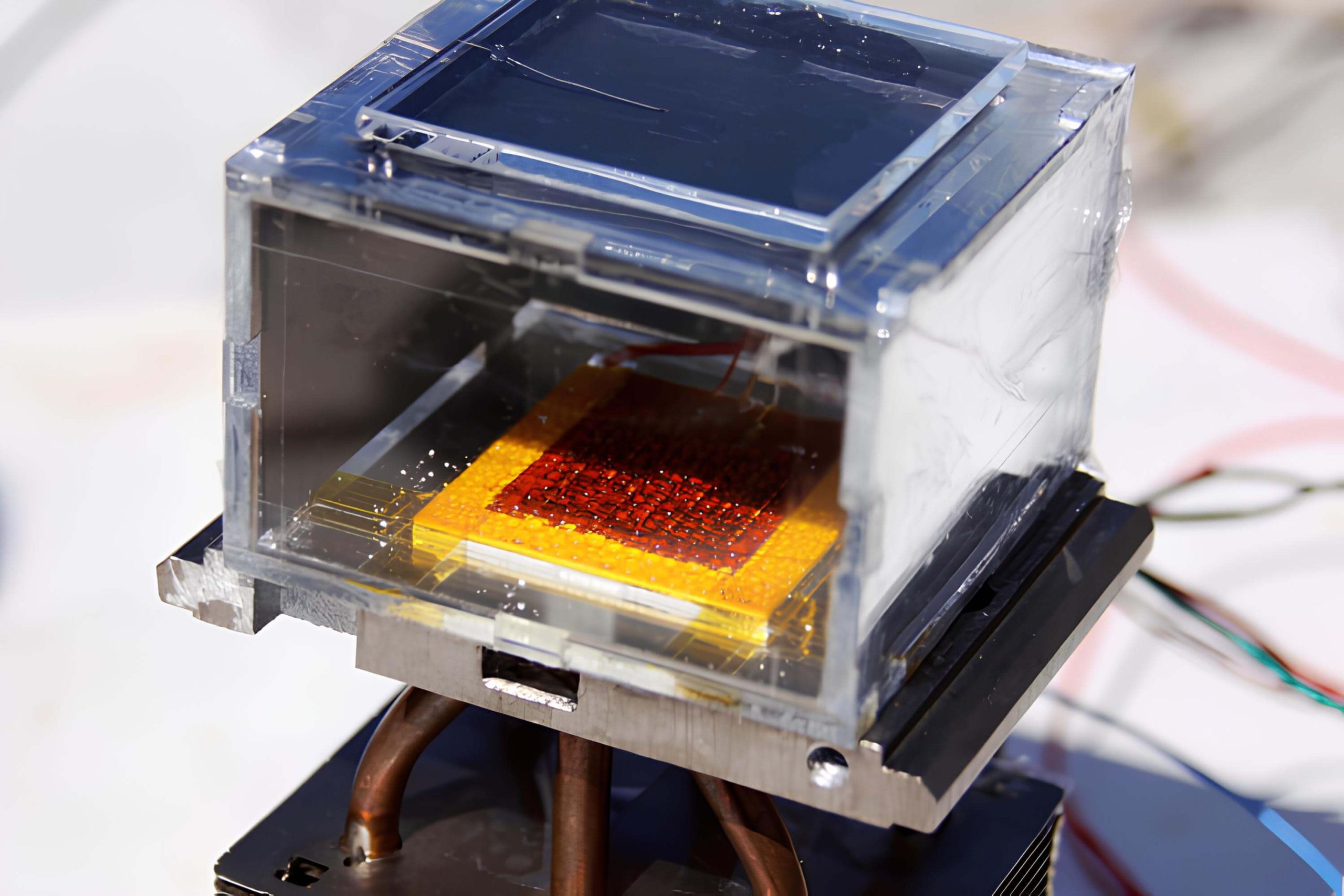
At the core of the device is MOF-303, a zirconium-based framework that’s been fine-tuned for maximum water uptake and efficient cycling. When ambient air passes through the device, the MOF captures water vapor and holds it within its porous structure. As sunlight heats the material, the captured moisture is released and condensed into liquid water using a simple passive condenser — no external power or moving parts required.
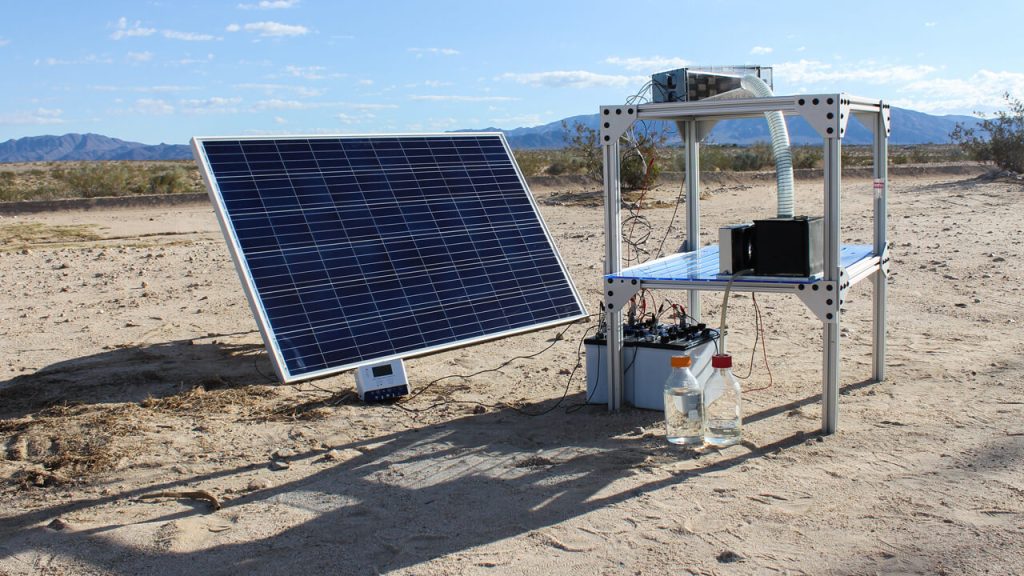
The technical specs are just as impressive as the concept. In lab tests, a small prototype weighing under 1 kg produced about 0.7 liters of water per day in environments with around 20% humidity. In more humid regions (40%–60%), yields increased significantly, reaching over 1.5 liters per kg of MOF. Importantly, the team has already scaled up the system to a larger, field-ready unit weighing around 10 kg, capable of harvesting 3 to 5 liters of water per day under moderate humidity. Future iterations may push beyond 10 liters daily with optimized materials and better thermal insulation.
What sets this apart from other atmospheric water generators (AWGs) is its efficiency and portability. Conventional AWGs often require compressors, fans, or refrigerants to condense moisture — making them energy-intensive and impractical for off-grid use. By contrast, UC Berkeley’s design uses only ambient solar heat and functions quietly without electricity, which means it can be deployed in rural, off-grid, or disaster-struck areas where infrastructure is limited or nonexistent.
The system is modular and scalable, designed for both individual and community-level deployment. Yaghi’s team envisions a future where these units could be installed on rooftops, in backyards, or embedded in off-grid infrastructure to provide a decentralized source of potable water. They’re also in talks with manufacturing partners to explore mass production using low-cost, abundant materials.
Another major highlight is the device’s longevity and low maintenance. MOF-303 has demonstrated stability over hundreds of adsorption-desorption cycles with minimal degradation. This means users wouldn’t need to frequently replace components or deal with filters and complicated upkeep. A well-sealed MOF unit could potentially last for several years with only occasional cleaning of the condenser and air intake.
The broader implications of this invention are significant. According to the United Nations, over 2 billion people currently live in water-stressed areas. With climate change intensifying droughts and water shortages globally, decentralized, renewable water harvesting technologies like this could help build resilience in both urban and remote communities. Moreover, the device could provide a safety net for humanitarian crises, emergency response units, and military deployments.
Funding for the project came from a mix of academic and private sources, including support from the Department of Energy and DARPA. The research has also sparked interest from global development NGOs and water-focused startups looking to commercialize similar tech for field use.
Of course, challenges remain. Scaling production of MOFs at industrial levels while maintaining low cost is a hurdle that the team is actively working to overcome. There’s also the need for field testing in diverse climates and environmental conditions to further validate reliability. Yet, with the foundational science solid and early field results promising, the path forward looks achievable.
Yaghi and his team remain optimistic. In a recent statement, he emphasized that this isn’t just a lab experiment but a blueprint for “personalized water” — a future where anyone, anywhere, can generate clean water using nothing but sunlight and air. That vision might sound like science fiction, but with UC Berkeley’s solar water-harvesting tech, it’s quickly becoming science fact.