

Third-generation mobile technology, popularly known as 3G, has been a cornerstone at the heart of mobile communication technology. It is a key milestone that ushered in a new age of fast and seamless mobile communication. Enabling faster data transmission rates than its predecessors, 3G brought about multimedia services and unprecedented connectivity on a global scale. As a crucial player, 3G provided faster internet browsing, significantly enhanced voice and data services. 3G users could access more sophisticated mobile services such as video calling, mobile TV, and real-time GPS navigation. These services were not feasible with the slower speeds of 2G networks.
Brief History of 3G
The journey to 3G began in the 1990s, when the demand for faster mobile data and internet access started to grow. While 1G offered analog voice and 2G introduced digital calling and basic texting, it was 3G that marked the true beginning of the mobile internet era.
The International Telecommunication Union (ITU) established the IMT-2000 standard in the late 1990s to unify global mobile networks under a common framework. It set key benchmarks for 3G, including data rates up to 2 Mbps, global roaming, and support for voice, data, and multimedia. This standard allowed different 3G technologies—like UMTS, CDMA2000, and TD-SCDMA—to work together and accelerated global adoption.
Japan became the first country to launch a commercial 3G network in 2001, led by NTT DoCoMo. Soon after, Europe, the U.S., and other regions followed. Based on the UMTS(Universal Mobile Telecommunications System) framework and using technologies like WCDMA (Wideband Code Division Multiple Access) and HSPA (High Speed Packet Access), 3G offered significantly faster mobile internet—marking the true start of the mobile data
How 3G Works
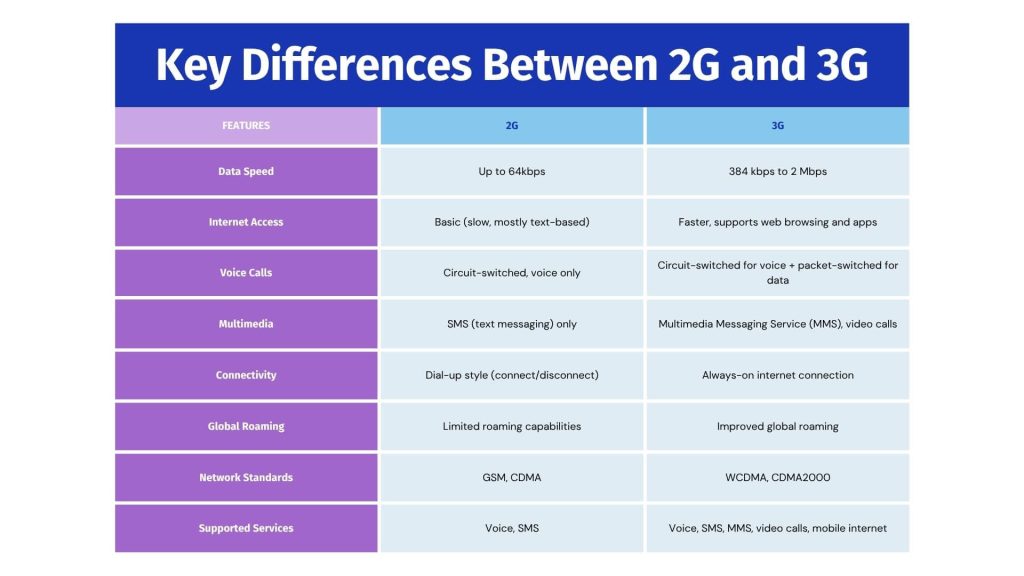
3G networks use two main methods to handle communication: circuit switching for voice calls and packet switching for data. Circuit switching is the traditional way phones connect during a call—setting up a dedicated line for the duration of the conversation. For data, like internet browsing or sending emails, 3G uses packet switching, which breaks information into small packets and sends them over the network more efficiently. This allows many users to share the network at once without needing a dedicated connection, making data transmission faster and more flexible than before.
3G technology is built on standards like WCDMA and CDMA2000, which help ensure devices and networks can work smoothly worldwide. It offers speeds ranging roughly from 384 kbps up to 2 Mbps, which was a big jump from earlier mobile networks. One major change 3G brought was the concept of “always-on” internet, meaning your device stays connected to the network all the time without dialing in each time you want to use data. This shift made mobile internet much more convenient and reliable, laying the foundation for the smartphones and apps we use today.
Features of 3G Technology
One of the biggest features of 3G technology was its higher data speeds, which made mobile internet much faster and more reliable than before. This improvement allowed users to browse the web, check emails, and use mobile apps with ease while on the move. For the first time, 3G also enabled video calling, letting people see and talk to each other directly from their phones—a huge step forward in mobile communication.
3G networks improved support for multimedia messaging (MMS), allowing users to send pictures, videos, and audio clips along with text messages. Global roaming was another important feature, making it easier for users to stay connected across different countries without changing devices or numbers. Together, these features helped transform mobile phones from simple calling tools into versatile devices for communication, entertainment, and productivity.
Integrating 3G Technology into Mobile Devices
The rise of smartphones like BlackBerry and early iPhones played a huge role in popularizing 3G technology. These devices were among the first to fully leverage 3G’s faster speeds and “always-on” connectivity, making mobile browsing, email, and even video calls practical for everyday users.
To support 3G, mobile devices required important hardware upgrades that can modulate and demodulate radio signals, such as new radio wave chips and mobile modems that could handle the different 3G signals and standards. These components allowed phones to connect smoothly to 3G networks and manage voice and high-speed data simultaneously. On the software side, operating systems and apps were improved to take full advantage of the increased speed and constant connection, enabling seamless web browsing, video streaming, and real-time communication. Meanwhile, 3G USB dongles brought mobile internet to laptops, and carriers promoted features like video calls and mobile browsing through attractive data plans, fueling the rapid growth and adoption of 3G technology.
Security in 3G Enhancing Mobile Security with 3G
With the introduction of 3G, mobile networks saw significant improvements in security compared to earlier generations. 3G technology includes stronger encryption methods to protect voice calls and data transmissions, making it much harder for unauthorized users to intercept or eavesdrop on conversations and online activities. This helped build trust for using mobile internet for sensitive tasks like banking or email.
Additionally, 3G networks introduced better user authentication processes, ensuring that only legitimate devices could connect to the network. These security enhancements made 3G a safer environment for both personal and business communication, laying the groundwork for even more advanced protections in later mobile technologies.
The Legacy and Sunset of 3G
3G was a groundbreaking technology that paved the way for today’s fast and connected mobile world. It introduced faster internet speeds, video calling, and multimedia messaging, transforming how people communicate and use their phones. However, as technology advanced, 3G’s limitations became more apparent. Its speeds and capacity are no longer sufficient to support modern demands like high-definition video streaming, large app downloads, and seamless cloud connectivity.
Because of this, many major carriers—such as AT&T, Verizon, and others—have begun shutting down their 3G networks to make room for newer, faster technologies like 4G LTE and 5G. While 3G is being phased out, its role in digital history remains important. It was the foundation that helped mobile internet become an everyday necessity, shaping the way we connect, work, and entertain ourselves on the go.
Conclusion
3G technology truly transformed the mobile landscape by introducing faster data speeds, video calling, and always-on internet connectivity. It marked the beginning of the mobile internet era and laid the foundation for the smartphones and apps we rely on today. Though it’s being phased out in favor of newer technologies like 4G and 5G, the legacy of 3G remains a crucial chapter in the evolution of mobile communication.